

Cleanroom Protective Clothing: A Complete Guide To Selection, Applications & Performance Standards
Nov 28, 2025
Choosing the right cleanroom protective clothing isn't just about regulatory compliance-it's about safeguarding product quality, protecting your team, and avoiding costly downtime. In industries like electronic semiconductors, pharmaceutical manufacturing, food processing, and biotech, cleanroom garments (also called sterile cleanroom suits, anti-static clean workwear, or controlled-environment apparel) act as the first line of defense against particulate and microbial contamination.
This guide breaks down everything you need to know: from core performance requirements and material selection to proper usage, industry-specific applications, and future trends. Whether you're outfitting an ISO Class 5 (Class 100) sterile lab or an ISO Class 8 (Class 100,000) production facility, we'll help you make informed decisions that align with your cleanroom classification and operational needs.
I. Why Cleanroom Protective Clothing Matters: More Than Just Dust Control
Human beings are the largest contamination source in controlled environments-shedding hair, skin particles, oils, and microbes continuously. Without proper cleanroom garments, these contaminants can severely affect product yields, safety, and regulatory compliance.
Cleanroom protective clothing provides three essential layers of protection:
1. Dual-Direction Contamination Control
External Barrier
- Prevents human-generated particles, hair, fibers, and microorganisms from entering sterile areas.
- Protects sensitive products such as microchips, pharmaceuticals, culture samples, and medical devices.
Internal Protection
- Shields personnel from chemicals, sterilizing gases, biological hazards, and fine particles.
2. Adaptation to Cleanroom Requirements
Cleanroom garments must deliver:
- Anti-static performance to prevent ESD (essential for electronics and semiconductor production).
- Low particle generation to avoid contaminating ultra-clean environments.
- Sterilization resistance, allowing for EO, steam, or gamma sterilization depending on industry needs.
- High breathability and comfort for long shifts on cleanroom production lines.
3. Compliance with Global Standards
High-quality cleanroom clothing supports compliance with international certifications:
- ISO 14644 Cleanroom Standards
- GMP (Good Manufacturing Practice)
- FDA requirements
- ESD S20.20
- GB/T 24249 cleanroom garment standards
II. Key Performance Metrics: How to Evaluate Cleanroom Garments
Not all cleanroom clothing is created equal. Use these 6 non-negotiable metrics to assess quality and suitability for your space:
|
Performance Metric |
Industry Benchmark |
Testing Standards |
Critical Use Cases |
|
Particle Generation |
≤350 particles/㎡ (≥0.5μm) |
ISO 14644-3, GB/T 24249 |
ISO Class 5–8 cleanrooms |
|
Microbiological Control |
Sterile (0 CFU/piece) or ≤10 CFU/piece |
ISO 11737, FDA 21 CFR Part 111 |
Pharmaceuticals, biotech, medical devices |
|
Anti-Static Efficacy |
Surface resistivity: 10⁶–10¹¹Ω; Friction voltage: ≤100V |
ANSI/ESD S20.20, IEC 61340-5-1 |
Electronics, semiconductor manufacturing |
|
Liquid Barrier Protection |
Hydrostatic pressure ≥1.67kPa; No leakage |
AATCC 42, ISO 811 |
Liquid handling (e.g., drug formulation, food processing) |
|
Breathability |
Air permeability ≥10 L/(㎡·s) |
ISO 9237, GB/T 5453 |
Long-duration shifts (8+ hours) |
|
Sterilization Durability |
≥100 sterilization cycles without performance loss |
ISO 11135 (EO), ISO 11134 (autoclave) |
Reusable garments (pharmaceutical, lab settings) |
Bonus Considerations
- Sealability: Tight-fitting cuffs, elasticized waistbands, and zipper flaps prevent gaps where particles can escape.
- Tear Resistance: Tensile strength ≥300N/5cm to withstand daily wear (critical for reusable options).
- Chemical Compatibility: Resists degradation from solvents, acids, or bases (test with your specific chemicals).
III. Common Materials Used in Cleanroom Protective Clothing
Cleanroom garments vary depending on their materials, which directly impact cleanliness, durability, and liquid/particle barrier capabilities.
1. Polyester (PET) Fabric - Reusable & Economical
- Low particle-linting
- Often woven with conductive fibers
- Suitable for ISO Class 7–8 cleanrooms
- Ideal for electronics, food processing, and cosmetic manufacturing
2. Polypropylene (PP) Non-Woven (SMS / SMMS) - Best for Disposable Use
- Lightweight, breathable, and cost-effective
- Common in ISO Class 6–8 cleanrooms
- Used in laboratories, healthcare, and short-duration cleanroom tasks
- Requires additional anti-static treatment
3. DuPont™ Tyvek® - Premium High-Protection Material
- Ultra-low particle release
- Excellent liquid and microbial barrier
- Highly tear-resistant and breathable
- Standard material for sterility-intensive industries such as pharmaceuticals and semiconductors
4. Anti-Static Composite Fabrics - Designed for High-Tech Manufacturing
- Prevent static discharge
- Specialized for semiconductor fabs, precision electronics, lithium battery manufacturing
IV. How to Choose the Right Cleanroom Protective Clothing (4-Step Guide)
Follow these 4 steps to choose cleanroom clothing that fits your needs (and budget):
Step 1: Start with Your Cleanroom Classification
- ISO Class 5 (Class 100): Opt for Tyvek® or sterile composite fabrics (disposable or sterilizable reusable). Prioritize zero particle shedding.
- ISO Class 6–7 (Class 1,000–10,000): PP non-woven (disposable) or anti-static polyester (reusable) works well. Balance protection and cost.
- ISO Class 8 (Class 100,000): Polyester reusable garments or basic PP non-woven-no need for over-engineering.
Step 2: Match to Industry Requirements
Pharmaceutical & Healthcare
- Sterile
- Low particle generation
- Steam/EO sterilization resistant
- GMP compliant
Semiconductor & Electronics
- Strong electrostatic dissipation
- Ultra-low particle shedding
Biotechnology & Biological Labs
- High liquid barrier
- Microbial protection
- Disposable recommended
Food Processing
- Antibacterial fabrics
- Reusable polyester is common
Step 3: Choose Disposable vs. Reusable
|
Type |
Best For |
Total Cost of Ownership |
Environmental Impact |
|
Disposable |
Short-term projects, high contamination risks |
Higher (replacement costs) |
More waste (look for recyclable options) |
|
Reusable |
Long-term production, stable teams |
Lower (50–70% savings over 2 years) |
Eco-friendly (reduces carbon footprint by 58%) |
Step 4: Evaluate Design and Fit
- Hooded coveralls for maximum coverage
- Elastic or Velcro cuffs
- Sealed seams
- Zippers with protective flaps
- Clearly labeled cleanliness and ESD ratings
V. Proper Usage & Maintenance for Maximum Protection
Even the best cleanroom garment will fail if not used correctly.
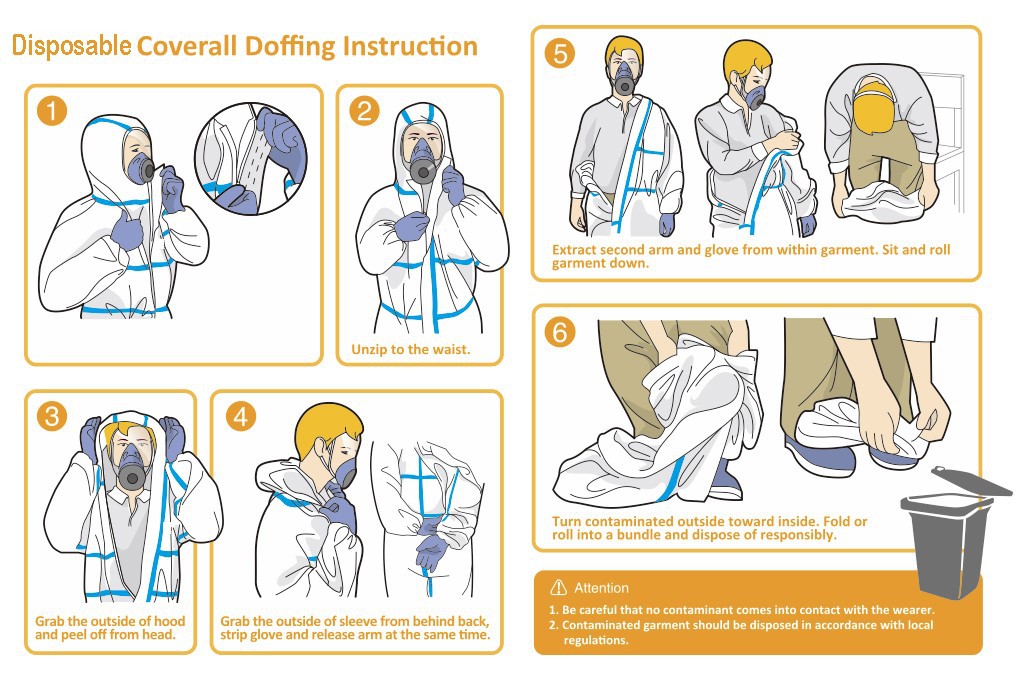
1. Proper Donning & Doffing Procedures
- Follow step-by-step dressing sequences
- Avoid touching garment exteriors
- Use air showers when applicable
- Correct procedures significantly reduce contamination risks.
2. Maintenance of Reusable Cleanroom Garments
- Wash with specialized detergents
- Avoid bleach or harsh chemicals
- Store in sealed, sterile packaging
- Replace garments that show damage, poor ESD performance, or excessive linting
3. Guidelines for Disposable Cleanroom Apparel
- Use once only
- Discard according to medical or industrial waste guidelines
- Inspect packaging integrity before use
VI. Key Industry Applications of Cleanroom Protective Clothing
Cleanroom protective clothing is essential across multiple hygiene-critical and high-tech industries. Different sectors require different protection levels, and choosing the right garment directly affects product quality, safety, and regulatory compliance. Below are the key application scenarios-now enhanced with recommended product types from LIONCARE, including Tyvek® alternatives, SMS coveralls, and the high-performance C900 chemical-resistant series.
1. Pharmaceutical Manufacturing - Sterility, Compliance & Microbial Control
Pharmaceutical cleanrooms require garments that deliver consistent sterility and minimal particle release while complying with GMP and FDA standards.
Key Requirements
- Sterile, non-linting materials
- EO/steam resistant
- Compatible with aseptic environments
- High microbial barrier
Common Garment Types
- Sterile cleanroom coveralls (hooded, integrated boot options)
- Cleanroom hoods, masks, beard covers
- Sterile nitrile gloves
- Boot covers and shoe covers
- Laboratory gowns / isolation gowns
- Cleanroom aprons for liquid handling
Recommended LIONCARE Products
LIONCARE SMS Sterile Coveralls - ideal for aseptic filling and sterile manufacturing lines.
LIONCARE Tyvek®-Alternative Microporous Film Coveralls - offering DuPont-like performance at a more economical cost, suitable for ISO Class 5–7 pharmaceutical areas.
Application Examples
- Vaccine filling rooms
- Sterile drug compounding
- Injectable dosage manufacturing
- Biopharma production
2. Semiconductor & Electronics Manufacturing - Ultra-Low Particles & ESD Control
Semiconductor and electronics environments require extremely low particle emission garments with stable electrostatic dissipation.
Key Requirements
- Strong anti-static performance (10⁶–10⁹ Ω)
- Ultra-low particle release
- Lightweight and breathable
- Non-abrasive to sensitive components
Common Garment Types
- Anti-static cleanroom coveralls
- Cleanroom frocks for ISO 7–8 zones
- Hoods and helmets for full-body coverage
- ESD boots & boot covers
- ESD-safe nitrile gloves
- Sleeve protectors for wafer handling
Recommended LIONCARE Products
LIONCARE C900 Chemical-Resistant Cleanroom Coverall - offers exceptional particle control, splash resistance, and anti-static performance for semiconductor fabs.
Application Examples
- Wafer fabs
- Chip packaging lines
- LCD/OLED module assembly
- Lithium battery production
3. Food & Beverage Processing - Hygiene, Cleanliness & Lightweight Protection
Food production focuses on preventing microbial contamination, ensuring operator hygiene, and using cost-effective protective garments.
Key Requirements
- Antibacterial or food-grade safe fabrics
- Lightweight and breathable
- Easy cleaning or disposable designs
- HACCP-compliant materials
Common Garment Types
- Disposable SMS/SMMS coveralls
- Food-grade smocks or lab coats
- Bouffant caps and beard nets
- Aprons (PE or TPU waterproof aprons)
- Non-slip shoe covers
- Sleeve covers and food-safe gloves
Recommended LIONCARE Products
LIONCARE SMS Disposable Coveralls - widely used in food packaging, beverage bottling, and meat processing plants due to low linting and excellent breathability.
LIONCARE PE/TPE Waterproof Aprons - ideal for wet operations or meat/seafood handling zones.
Application Examples
- Dairy processing
- Beverage filling lines
- Meat and poultry facilities
- Ready-to-eat food factories
4. Biotechnology & Biological Laboratories - Liquid Barriers & Hazard Control
Biotech and biological labs require high-barrier garments to protect staff from biological agents, chemicals, and aerosols.
Key Requirements
- Strong splash and aerosol protection
- Resistance to microorganisms and chemicals
- Preferably disposable to avoid cross-contamination
- Suitable for BSL-2/BSL-3 environments
Common Garment Types
- Disposable high-barrier coveralls (SMS, SMMS, MP-coated)
- Tyvek® 600/800-style protective suits
- Lab coats and fluid-resistant gowns
- Face shields and goggles
- High boot covers or integrated boot suits
- Chemical-resistant aprons
- Double nitrile gloves
Recommended LIONCARE Products
LIONCARE C900 Chemical-Resistant Coverall - excellent for BSL-2 and BSL-3 labs, combining superior liquid barrier, chemical splash resistance, and low particle emission.
LIONCARE Microporous Film (MP) Coveralls - an effective Tyvek® alternative for biotech labs seeking high protection at competitive pricing.
Application Examples
- Microbiology testing
- Genetic editing (CRISPR) labs
- Vaccine R&D
- Infectious disease diagnostics
- Biotech pilot-scale labs
VII. Future Trends in Cleanroom Protective Clothing
The cleanroom clothing industry is evolving to meet stricter regulations, sustainability goals, and technological advances:
1. Sustainable Innovation
Degradable Materials: Biodegradable PP non-wovens and bio-based polyester fabrics (reduce landfill waste).
Circular Economy: Recyclable Tyvek® and reusable garments with extended lifespans (≥200 sterilization cycles).
Carbon-Neutral Production: Manufacturers adopting renewable energy to power fabric production.
2. Smart Technology Integration
RFID Traceability: Track garment batches, sterilization cycles, and usage duration (simplifies compliance).
Sensor-Embedded Garments: Real-time monitoring of ESD levels, fabric integrity, and worker body temperature.
Ergonomic Design: 3D-printed custom fits and moisture-wicking fabrics (reduce fatigue during 12-hour shifts).
3. High-Performance Composites
Multifunctional Fabrics: Combine anti-static, liquid barrier, and antibacterial properties in one material.
Ultra-Low Particle Shedding: Fabrics designed for ISO Class 4 (Class 10) cleanrooms (≤100 particles/㎡).
Chemical-Resistant Layers: Enhanced protection against harsh solvents (critical for advanced manufacturing).
Conclusion: Choosing the Right Cleanroom Garments Protects Your Products, People & Compliance
Choosing the right cleanroom protective clothing is a strategic decision that impacts quality, safety, and bottom-line results. Whether you need disposable Tyvek® suits for a lab or reusable anti-static coveralls for a production line, our team of experts can help you find the perfect solution.
Get a free consultation today: Tell us your cleanroom class, industry, and budget, and we'll provide personalized recommendations-including fabric samples and compliance documentation. Let's build a contamination-free environment that drives your success.


