How To Evaluate The Production Capacity Of A Disposable PPE Manufacturer
Aug 06, 2026
The COVID-19 pandemic permanently changed how global buyers evaluate PPE suppliers. Price is no longer the only factor. Today, importers, distributors, government procurement agencies, and industrial safety brands pay much closer attention to PPE production capacity, supply chain resilience, and long-term manufacturing capability.
Whether you're sourcing disposable coveralls, isolation gowns, surgical gowns, lab coats, shoe covers, or other disposable protective clothing, selecting the right manufacturing partner can significantly reduce delivery risks and improve your competitive advantage.
But how can buyers determine whether a manufacturer truly has the production capability they claim?
This guide explains the most important factors professional buyers evaluate before placing large-volume PPE orders and provides practical methods for verifying a disposable clothing factory beyond marketing materials.
Why Production Capacity Matters More Than Unit Price
Many suppliers can produce samples.
Far fewer can consistently manufacture hundreds of thousands-or even millions-of pieces while maintaining quality, compliance, and delivery schedules.
Insufficient production capacity often leads to:
- Delivery delays
- Inconsistent product quality
- Capacity shortages during peak seasons
- Higher defect rates
- Unstable lead times
- Increased procurement costs
For distributors serving hospitals, industrial safety companies, government tenders, and OEM brands, these risks directly affect customer satisfaction and business reputation.
Choosing a factory with proven manufacturing capacity reduces these risks considerably.

1. Evaluate the Size of the Manufacturing Facility
A factory's physical footprint provides one of the earliest indicators of production capability.
Ask suppliers about:
- Factory floor area
- Number of workshops
- Cutting departments
- Sewing lines
- Packaging areas
- Warehouses
- Raw material storage capacity
A modern disposable clothing factory usually separates production into specialized zones to improve efficiency and reduce contamination risks.
Look for organized workflows instead of crowded production areas.
2. Check the Number of Production Lines
Production lines determine how many orders can be processed simultaneously.
Ask questions such as:
- How many sewing lines are available?
- How many ultrasonic welding machines are operating?
- Are different product categories produced on dedicated lines?
- Can production be expanded during peak demand?
Factories with multiple independent production lines typically have greater scheduling flexibility.
This is especially important when ordering several product categories at once.
For example:
- Disposable coveralls
- Isolation gowns
- Surgical gowns
- Shoe covers
- Bouffant caps
can often be manufactured simultaneously without affecting lead times.

3. Understand Monthly PPE Production Capacity
Rather than asking vague questions like "How much can you produce?", request measurable data.
Professional manufacturers should be able to provide estimated monthly capacity for each product.
Examples include:
| Product | Monthly Capacity |
|---|---|
| Disposable Coveralls | 400,000 pcs |
| Isolation Gowns | 1,000,000 pcs |
| Surgical Gowns | 500,000 pcs |
| Shoe Covers | 6,000,000 pairs |
| Bouffant Caps | 8,000,000 pcs |
Comparing capacity across product categories helps buyers determine whether a supplier is suitable for long-term procurement.
LIONCARE PPE Production capacity
4. Review Workforce Stability
Production equipment is only part of the equation.
A stable workforce is equally important.
Consider asking:
- Number of full-time workers
- Average employee retention
- Training programs
- Shift arrangements
- Seasonal labor dependency
Factories relying heavily on temporary workers may experience inconsistent product quality during busy seasons.
Experienced operators usually produce more consistent PPE garments with fewer defects.
5. Assess Material Supply Chain Stability
Production capacity also depends on raw material availability.
For disposable protective clothing, key materials include:
- SMS nonwoven fabric
- Microporous film laminate
- Polypropylene nonwoven
- PE-coated materials
- Elastic bands
- Zippers
- Sewing thread
- Adhesive tape
Ask suppliers:
- Do they maintain safety stock?
- How many material suppliers do they have?
- Can they handle sudden increases in demand?
Factories with diversified sourcing strategies are generally better prepared for global supply disruptions.
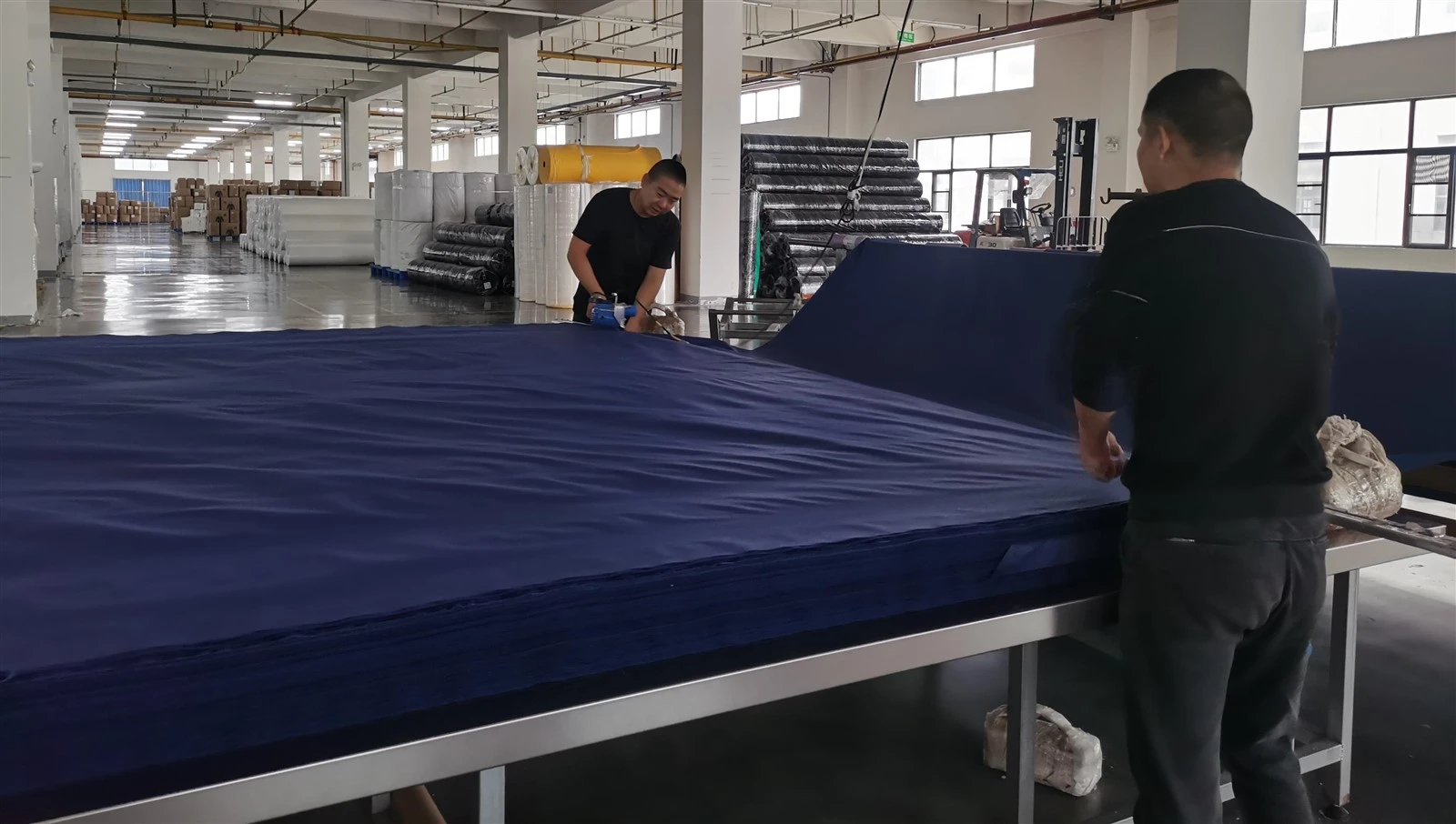
6. Verify Equipment Investment
Modern manufacturing equipment improves productivity and consistency.
Look for factories equipped with:
- Automatic cutting machines
- Ultrasonic welding machines
- Pattern cutting systems
- Elastic attaching equipment
- Heat sealing equipment
- Automatic folding machines
- Carton packing systems
- Metal detection equipment (if required)
Equipment investment often reflects a manufacturer's long-term commitment to quality and scalability.
7. Review Quality Control Capacity
High production output is meaningless without reliable quality management.
Ask how inspections are conducted throughout production.
Typical checkpoints include:
Incoming Material Inspection
- Fabric weight
- Material thickness
- Color consistency
- Certification verification
In-Process Inspection
- Stitch quality
- Seam strength
- Size measurement
- Welding performance
- Visual appearance
Final Inspection
- Packaging
- Label verification
- Carton inspection
- Random sampling
A mature quality system should be integrated into every production stage-not just the final inspection.
8. Evaluate OEM and Private Label Experience
Production capacity also includes operational flexibility.
If you're building your own PPE brand, ask whether the factory supports:
- Custom logo printing
- Private packaging
- Barcode labeling
- Instruction manuals
- Multiple carton designs
- Retail packaging
- Pallet configuration
Experienced OEM manufacturers typically manage custom projects more efficiently while maintaining delivery schedules.
9. Ask for Real Production Evidence
Professional buyers rarely rely solely on brochures.
Instead, request evidence such as:
- Factory videos
- Production line photos
- Workshop walkthroughs
- Warehouse images
- Container loading photos
- Customer audit reports
- Third-party inspection reports
Authentic manufacturing documentation provides greater confidence than generic product catalogs.
10. Evaluate Delivery Performance
A supplier's production capacity is ultimately reflected in on-time delivery.
Useful questions include:
- Average lead time
- Emergency production capability
- Peak-season capacity
- Export experience
- Major destination markets
Manufacturers serving Europe, North America, Australia, and the Middle East often have more mature export management systems.
Common Warning Signs
When evaluating a disposable clothing factory, pay attention to these potential concerns:
- Unable to provide factory photos
- No production videos
- Inconsistent capacity figures
- Extremely low prices
- No certifications
- Outsourced manufacturing without disclosure
- Long response times
- Unclear production schedules
These signs do not automatically indicate poor performance, but they warrant further verification before placing large orders.
Why Global Buyers Choose Lioncare
As an experienced disposable clothing factory, Lioncare supports global PPE distributors, importers, industrial safety companies, healthcare suppliers, and private-label brands with scalable manufacturing and dependable supply.
Our manufacturing strengths include:
- Large-scale production facility
- Multiple production lines for disposable PPE
- Experienced workforce
- Strict quality control throughout production
- OEM & private label services
- Export experience across Europe, North America, the Middle East, Africa, and other international markets
- Compliance with international PPE standards
- Flexible production planning for bulk orders
Whether you require disposable coveralls, isolation gowns, lab coats, or other disposable protective clothing, our team works closely with buyers to deliver consistent quality and reliable lead times.
👉Learn more about our manufacturing capabilities on our Factory Strengths page.
Final Thoughts
Evaluating PPE production capacity requires much more than reviewing a quotation.
Experienced buyers assess the entire manufacturing ecosystem-from facilities and equipment to workforce stability, raw material management, quality control, and delivery performance.
Taking the time to perform a comprehensive factory evaluation helps reduce procurement risks, improve supply chain resilience, and build long-term partnerships with manufacturers capable of supporting business growth.
For organizations seeking a dependable disposable clothing factory, selecting a supplier with transparent production capabilities is one of the most valuable investments you can make.
FAQ
Q: What is PPE production capacity?
A: PPE production capacity refers to the maximum number of personal protective equipment products a manufacturer can produce within a specific timeframe, usually measured monthly or annually. It reflects not only equipment but also workforce, raw materials, and operational efficiency.
Q: Why is production capacity important when choosing a PPE supplier?
A: A manufacturer with sufficient production capacity is more likely to deliver orders on time, maintain consistent product quality, and handle unexpected increases in demand without disrupting your supply chain.
Q: How can I verify whether a disposable clothing factory has real manufacturing capability?
A: You can request factory audit reports, production videos, workshop photos, equipment lists, production capacity data, certifications, and references from previous international customers. Third-party factory inspections are also recommended for large procurement projects.
Q: Does a larger factory always mean better production capacity?
A: Does a larger factory always mean better production capacity?
Q: Does a larger factory always mean better production capacity?
A: Yes. Lioncare provides OEM and private label manufacturing services, including customized packaging, logo printing, labeling, and product specifications for distributors, importers, wholesalers, and global PPE brands.